Why Another Booking Platform?
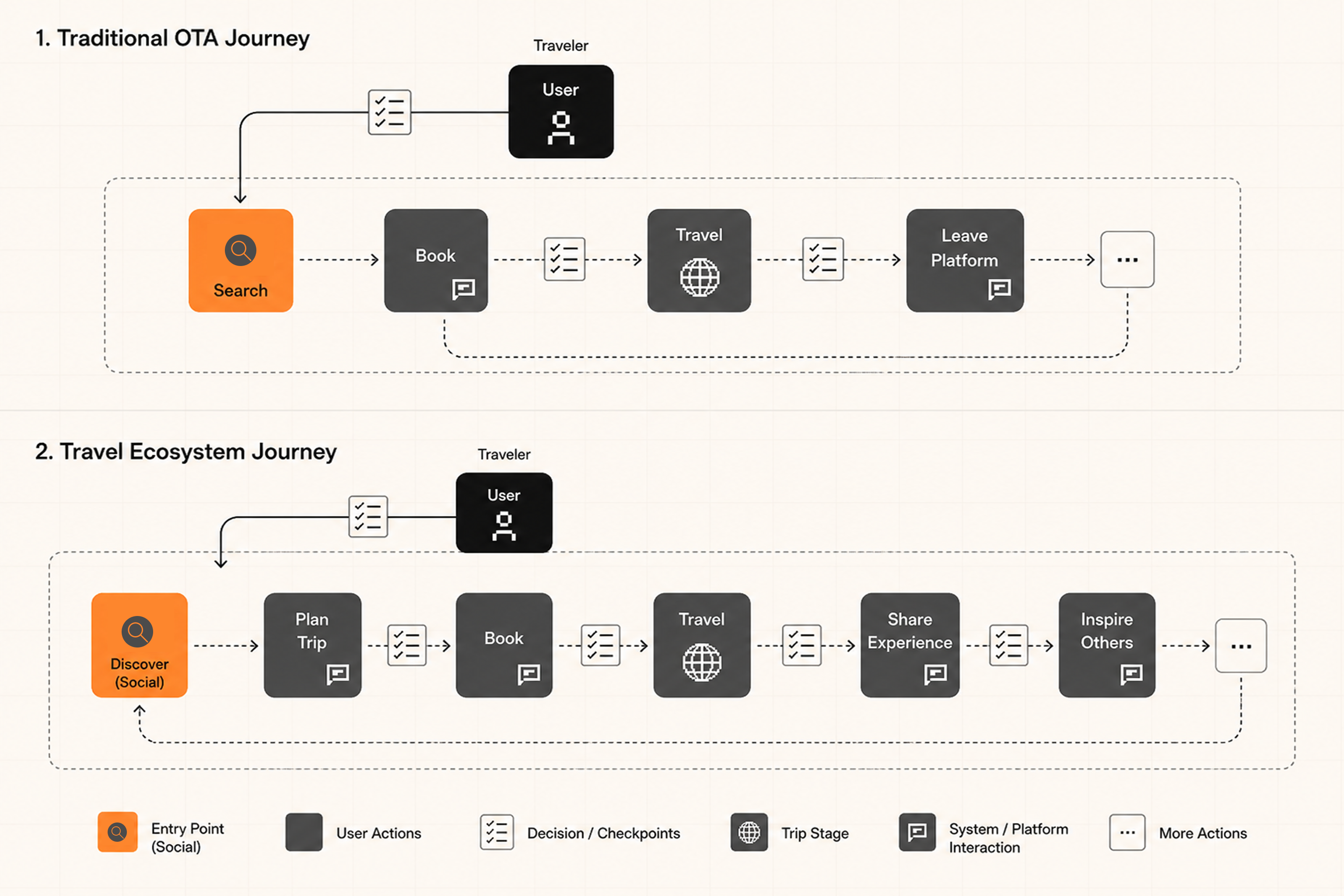
Travel booking is often treated as a standalone experience.
Users open an app, search for a hotel or flight, complete their booking, then leave.
Our product took a different approach.
Instead of building another booking app, we were building a travel ecosystem where Social became the entry point for discovery, inspiration, and community. Booking was designed as a natural continuation of that journey, allowing travelers to move seamlessly from discovering a destination to planning and purchasing their trip without leaving the ecosystem.
As the platform expanded to Hotels, Flights, Cars, and Tours, maintaining a consistent experience across products became just as important as supporting increasingly complex business operations behind the scenes.
Scaling Beyond Booking
As the platform expanded across Hotels, Flights, Cars, and Tours, the complexity no longer came from individual booking flows. It came from coordinating travelers, partners, and internal operations while keeping the experience consistent and scalable.
My Responsibilities
One Platform, Three Perspectives
The project wasn’t designed as a standalone booking application. Instead, it was built as a travel commerce platform connecting three interconnected systems: the Traveler Experience, the Partner Center, and the Internal Operations Platform. Together, they formed a shared ecosystem where a single booking could seamlessly flow across users, partners, and business operations.
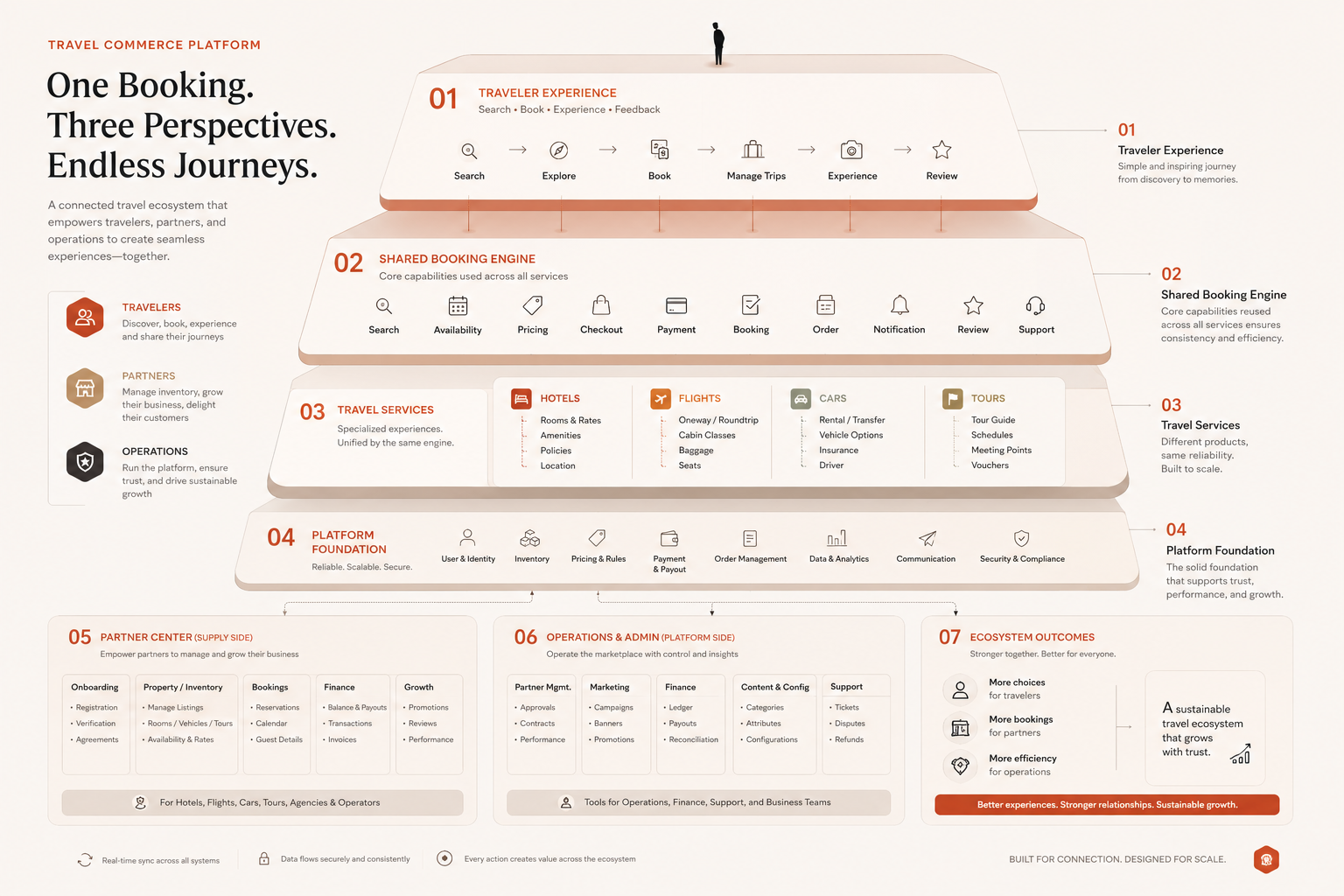
This case study follows a single booking as it moves through these interconnected platforms, revealing the hidden systems behind one simple action: "Book Now."
What Travelers See
From a traveler’s perspective, booking a trip feels remarkably simple. Search for a destination, compare options, complete the reservation, and start the journey. The entire experience appears to happen within just a few screens.
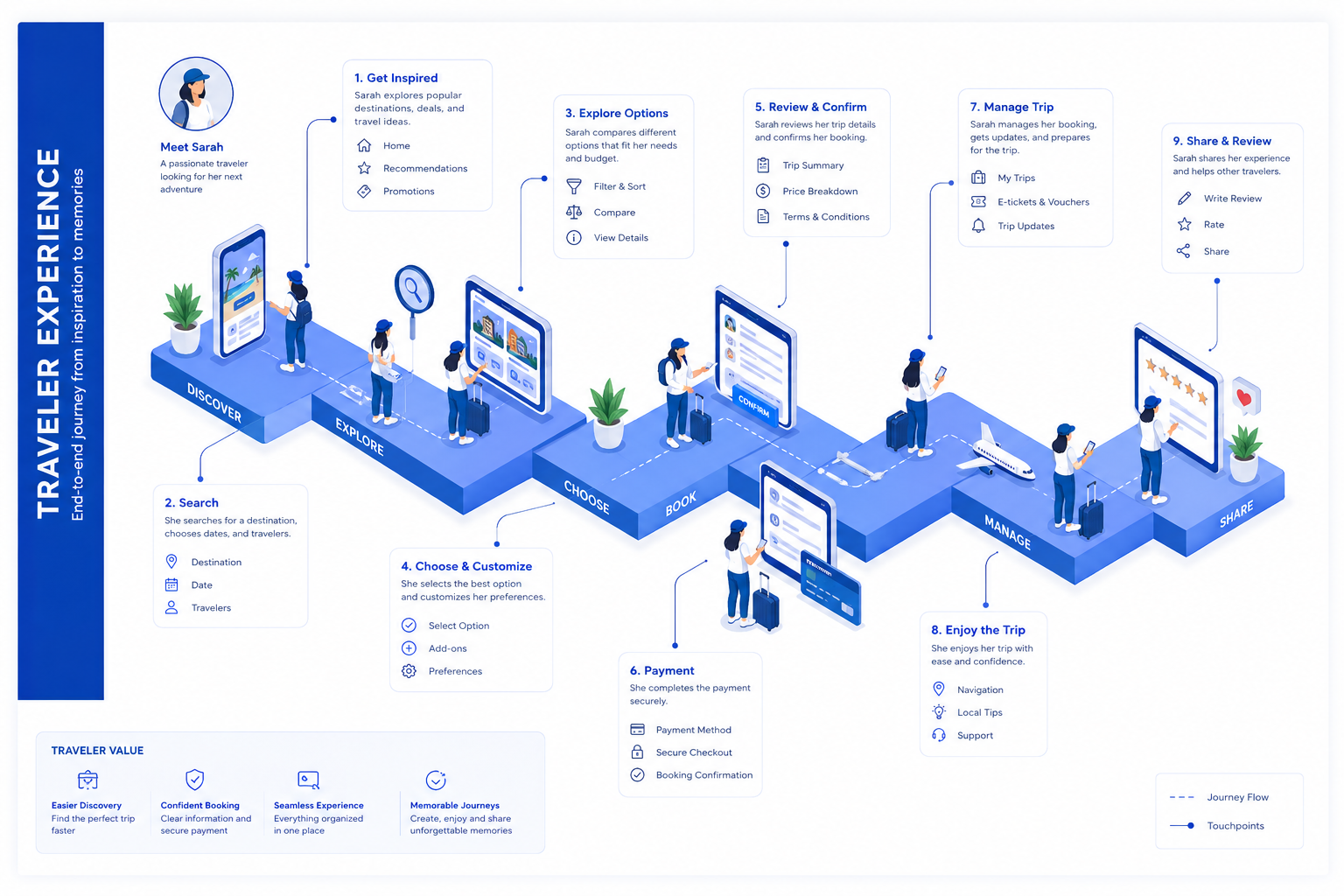
What Actually Happens
But what actually happens after someone clicks "Book Now"?
Behind that single action, one booking begins traveling through multiple systems, triggering business operations, partner workflows, financial processes, and customer support before the traveler even receives a confirmation.
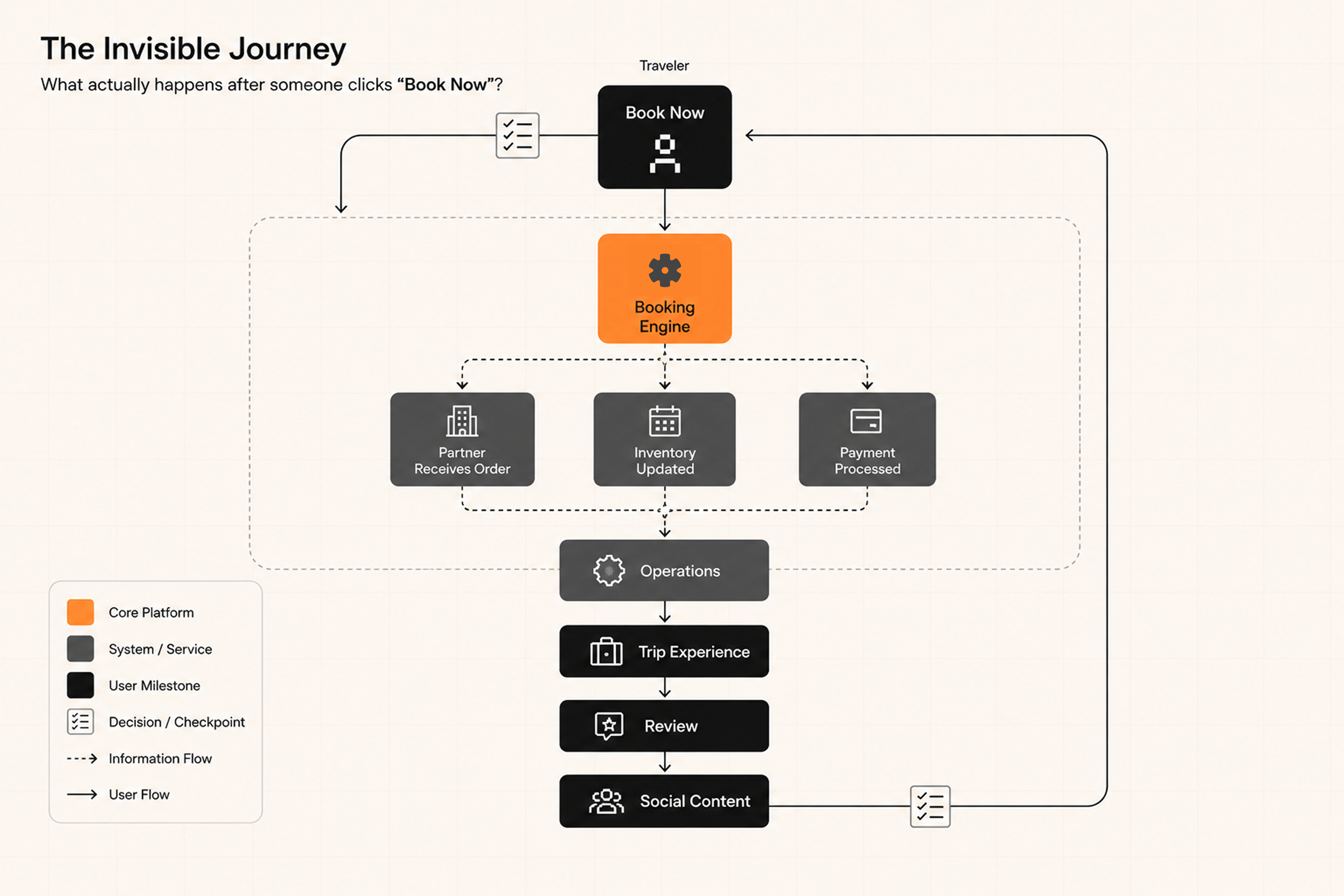
Following One Booking
Rather than documenting every feature across Hotels, Flights, Cars, and Tours, this case study follows a single Hotel booking from start to finish. By tracing one booking across the platform, it becomes easier to understand how user experience, business operations, and system design work together as one ecosystem.
Building Context
Before designing any booking experience, I needed to understand how a booking actually worked behind the scenes. Rather than starting with user interfaces, I traced the entire booking lifecycle across the people, systems, and business processes that made each reservation possible.
To build that understanding, I combined three complementary perspectives:
Together, these perspectives revealed that booking was more than a user flow. It was a shared business lifecycle connecting travelers, partners, and platform operations.
Mapping the Booking Lifecycle
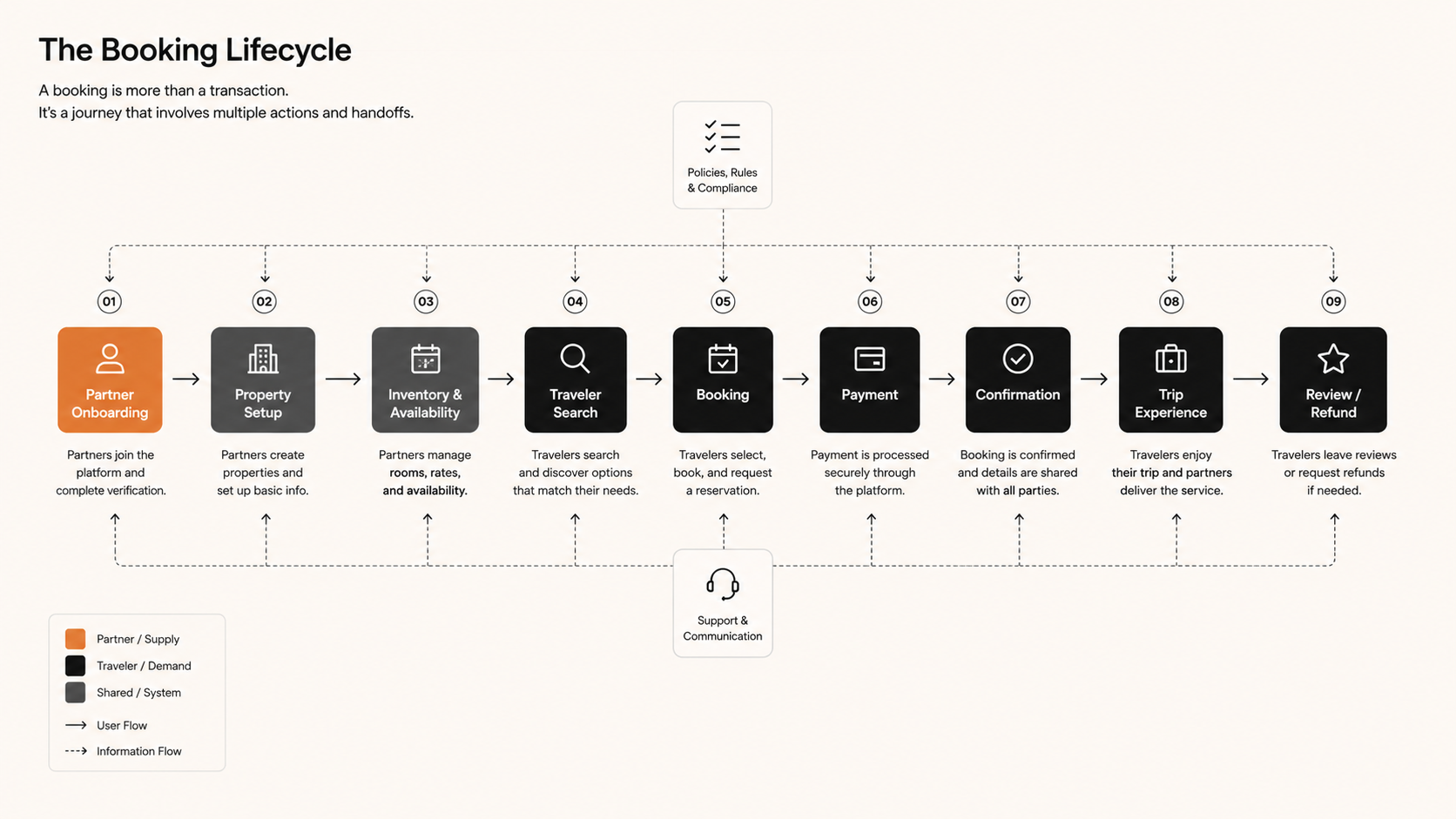
Instead of analyzing isolated features, I followed a single booking from the moment a partner joined the platform until the traveler completed the trip. This revealed that a booking was not a single interaction, but a shared lifecycle connecting multiple stakeholders over time.
The lifecycle began long before a traveler searched for a destination and continued even after the trip ended through reviews, refunds, and operational reporting.
Understanding the Stakeholders
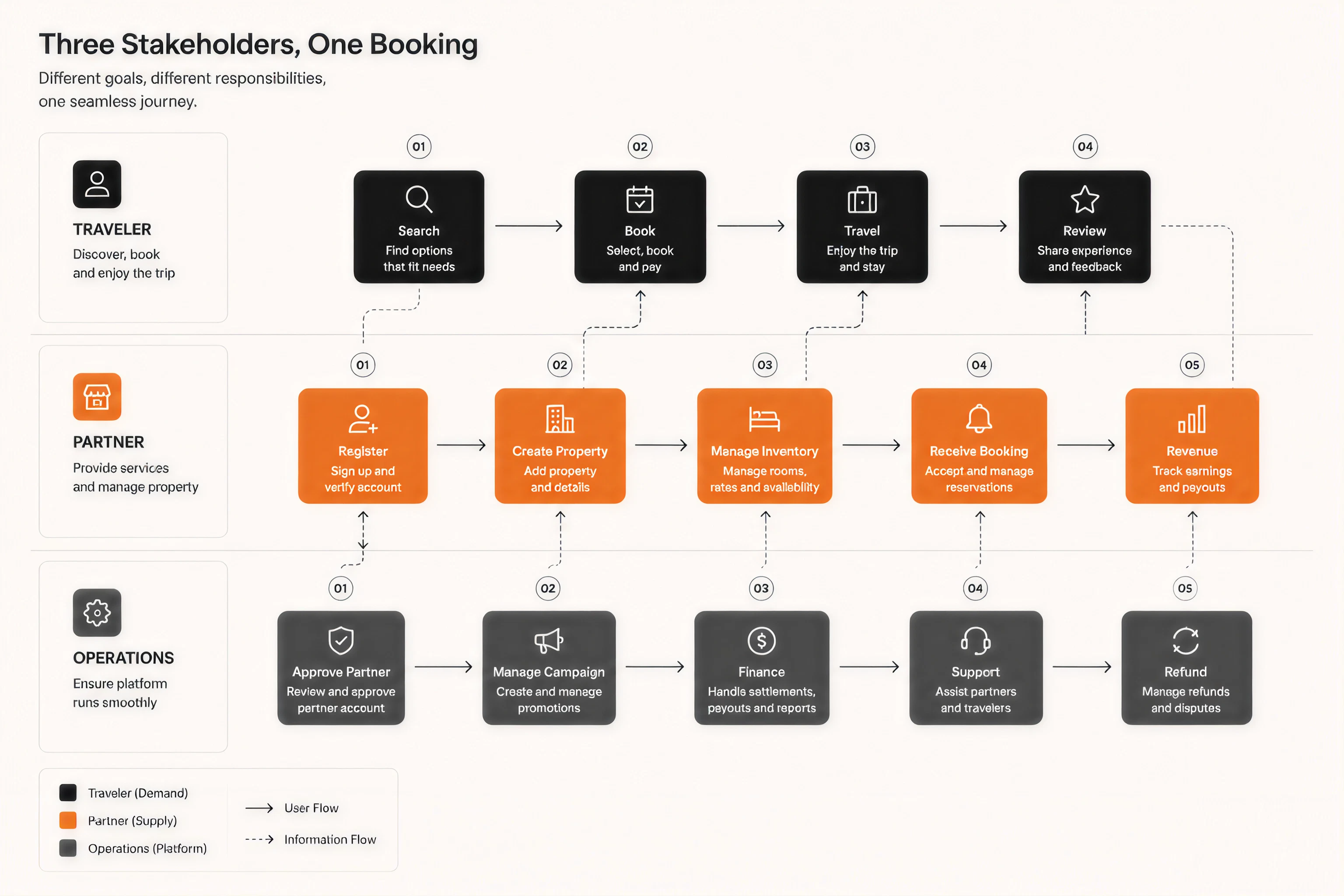
Although every stakeholder interacted with the same booking, each viewed it through a completely different lens.
For travelers, success meant completing the entire booking journey smoothly, without confusion, interruptions, or unexpected issues.
For partners, success meant managing inventory, reservations, and revenue efficiently.
For internal operations, success meant ensuring every transaction, workflow, and customer issue could be monitored and resolved reliably.
Understanding these different perspectives became essential before defining a shared platform experience.
Key Insights
Mapping the booking lifecycle revealed that the biggest challenges were not within individual screens, but within the coordination between systems, stakeholders, and business rules.
Several recurring patterns emerged throughout the research.
Insight 1:
One booking creates three different experiences.
Although travelers, partners, and operations interacted with the same booking, each required different information, workflows, and success metrics.
Design Implication: Create a shared booking lifecycle while tailoring experiences to each stakeholder.
Insight 2:
Different travel services followed similar operational patterns.
Hotels, Flights, Cars, and Tours all introduced unique business rules, yet shared the same fundamental lifecycle from inventory management to booking completion.
Design Implication: Separate reusable booking capabilities from service-specific logic.
Insight 3:
Operational complexity was largely invisible to travelers.
Most of the work happened behind the interface through inventory synchronization, payment processing, partner notifications, financial reconciliation, and customer support.
Design Implication: Design platform tools that absorb operational complexity instead of exposing it to users.
Design Opportunities
These insights shifted the project from improving individual booking flows to designing a scalable platform capable of supporting multiple services and stakeholders.
The platform needed to:
These opportunities became the foundation for the platform architecture explored in the next chapter.
Design Opportunities
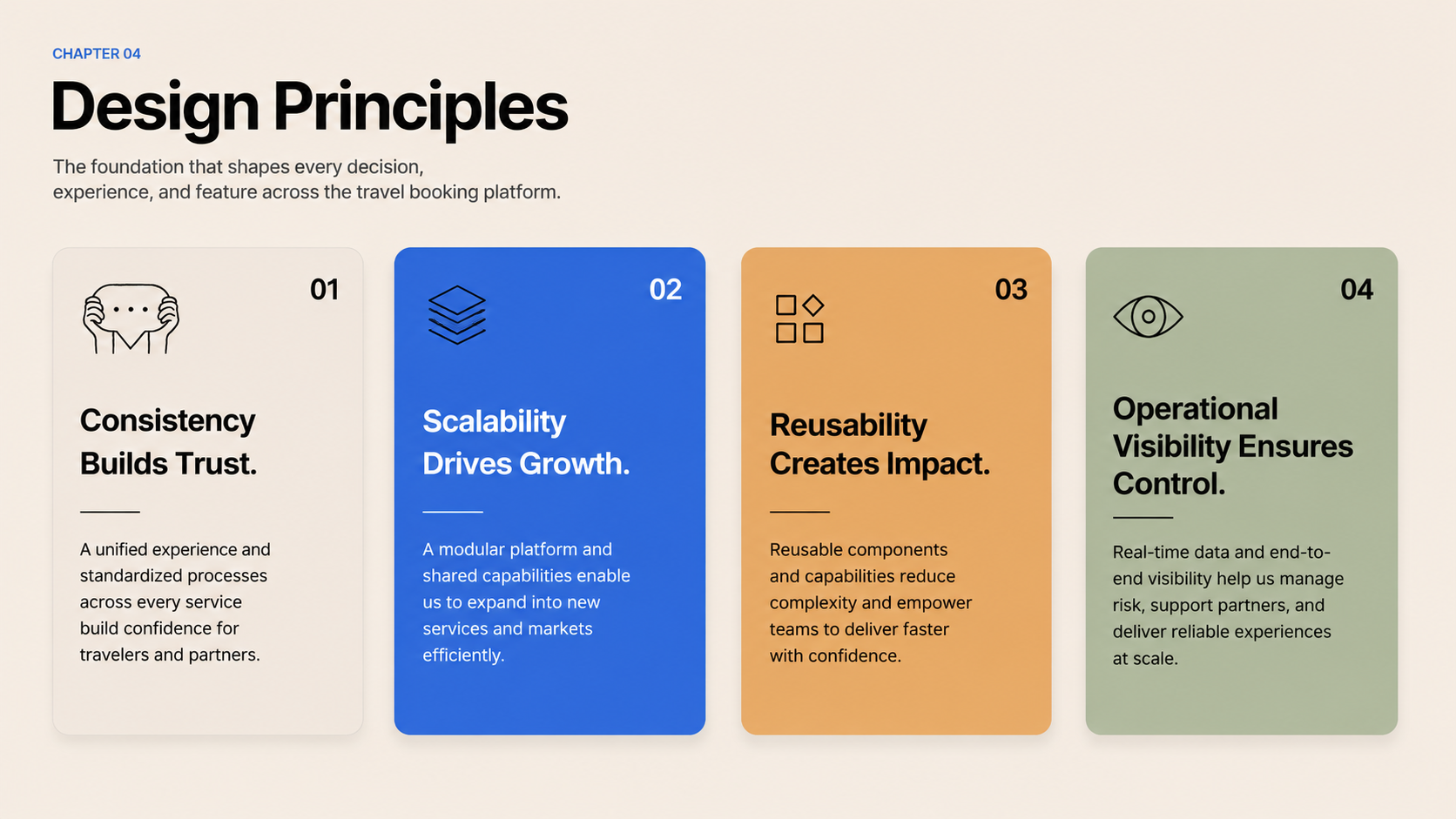
Before designing individual features, I established a set of shared principles to guide decisions across every travel service. These principles ensured that Hotels, Flights, Cars, and Tours could evolve independently while maintaining a consistent experience throughout the platform.
Rather than optimizing each product in isolation, the goal was to create a foundation that balanced user experience, operational efficiency, and long-term scalability.
Shared Booking Platform
The research revealed that every booking followed a similar lifecycle, regardless of the travel service. Instead of building separate solutions for each product, I designed a shared booking platform that centralized common capabilities while allowing service-specific business rules to remain flexible.
This approach enabled multiple products to operate on the same foundation, reducing duplicated effort and creating a more consistent experience for travelers, partners, and internal teams.
Shared Capabilities
Although each travel service introduced unique requirements, many capabilities were shared across the ecosystem. Search, booking, payment, vouchers, notifications, and reviews became reusable building blocks instead of being recreated for every service.
By treating these as platform capabilities rather than individual features, new services could be introduced with greater consistency and significantly less implementation effort.
Design Decisions
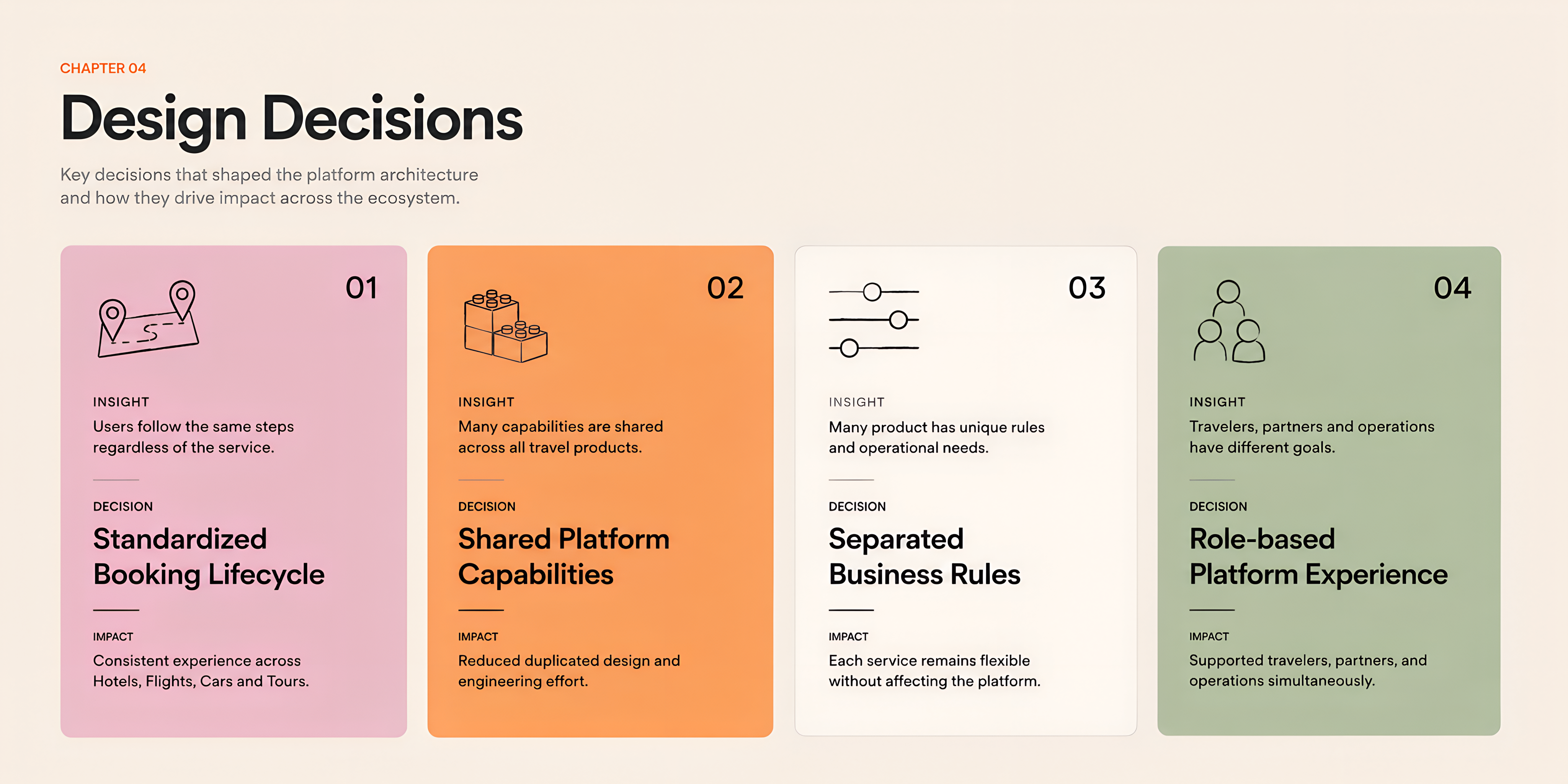
Each platform decision was driven by the patterns identified during the discovery phase rather than individual feature requests.
The booking lifecycle was standardized to reduce duplicated workflows across services.
Shared capabilities were separated from business-specific rules, allowing each product to remain flexible without compromising platform consistency.
Experiences were designed around the needs of travelers, partners, and operations simultaneously, ensuring that improvements for one stakeholder did not introduce unnecessary complexity for another.
Every Decision Has a Cost
Building a shared platform required balancing consistency with flexibility.
Standardizing common workflows reduced design and engineering overhead, but also required individual products to adapt to shared patterns instead of creating completely customized experiences.
Investing in reusable foundations increased the initial design effort, yet made future expansion across new travel services significantly more scalable.
With the platform architecture established, the next step was translating these principles into a real booking experience. The following chapter follows a single hotel booking to demonstrate how platform decisions became interface decisions.
THE SCENARIO
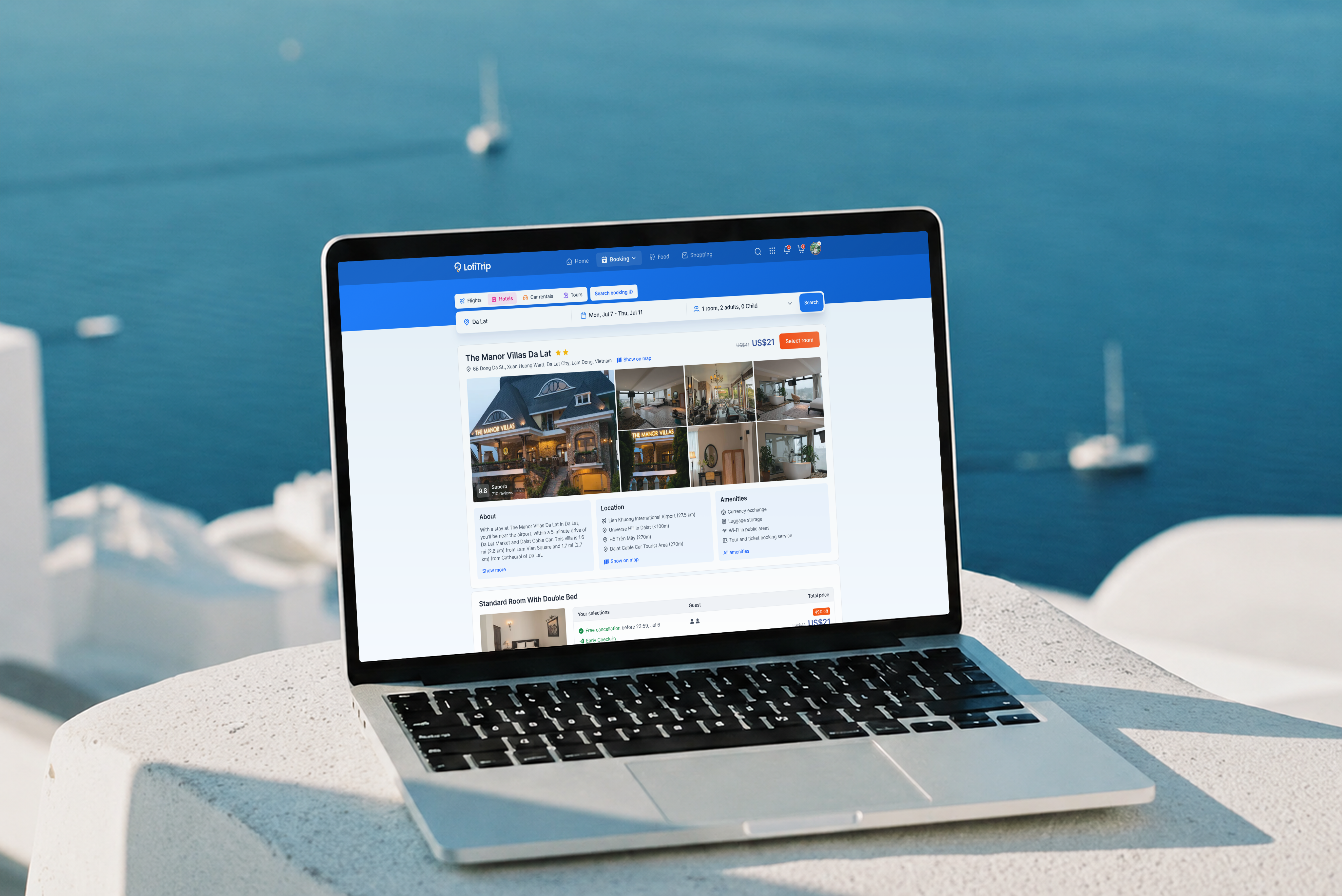
Rather than showcasing every travel service, I focused on a single hotel booking that represented the complete booking lifecycle. Hotels involved the richest set of interactions, from search and availability to payment, stay, reviews, and post-booking support, making it an ideal example of how the platform came together.
THE END-TO-END JOURNEY
The platform was designed to guide travelers through a seamless journey while orchestrating complex business processes behind the scenes. Every interaction was supported by shared platform capabilities established in the previous chapter.
Booking Flow
Payment Flow
KEY DESIGN DECISIONS
Rather than redesigning every screen independently, each interaction reflected decisions made at the platform level. Shared patterns improved consistency, while service-specific rules remained flexible where necessary.
Search results
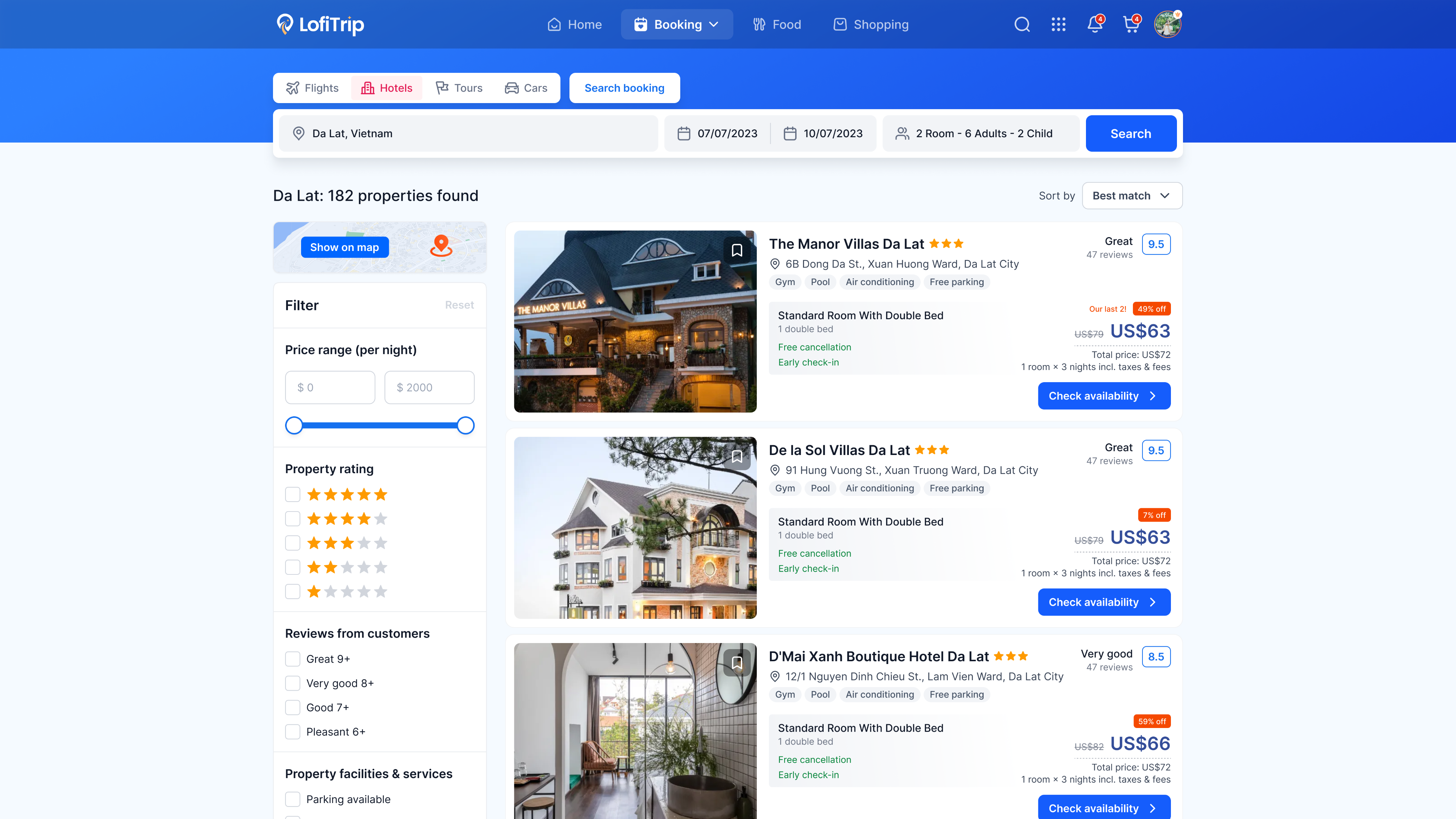
Simplified discovery through consistent filtering and sorting. Prioritized relevant information to reduce decision time.
Search on map
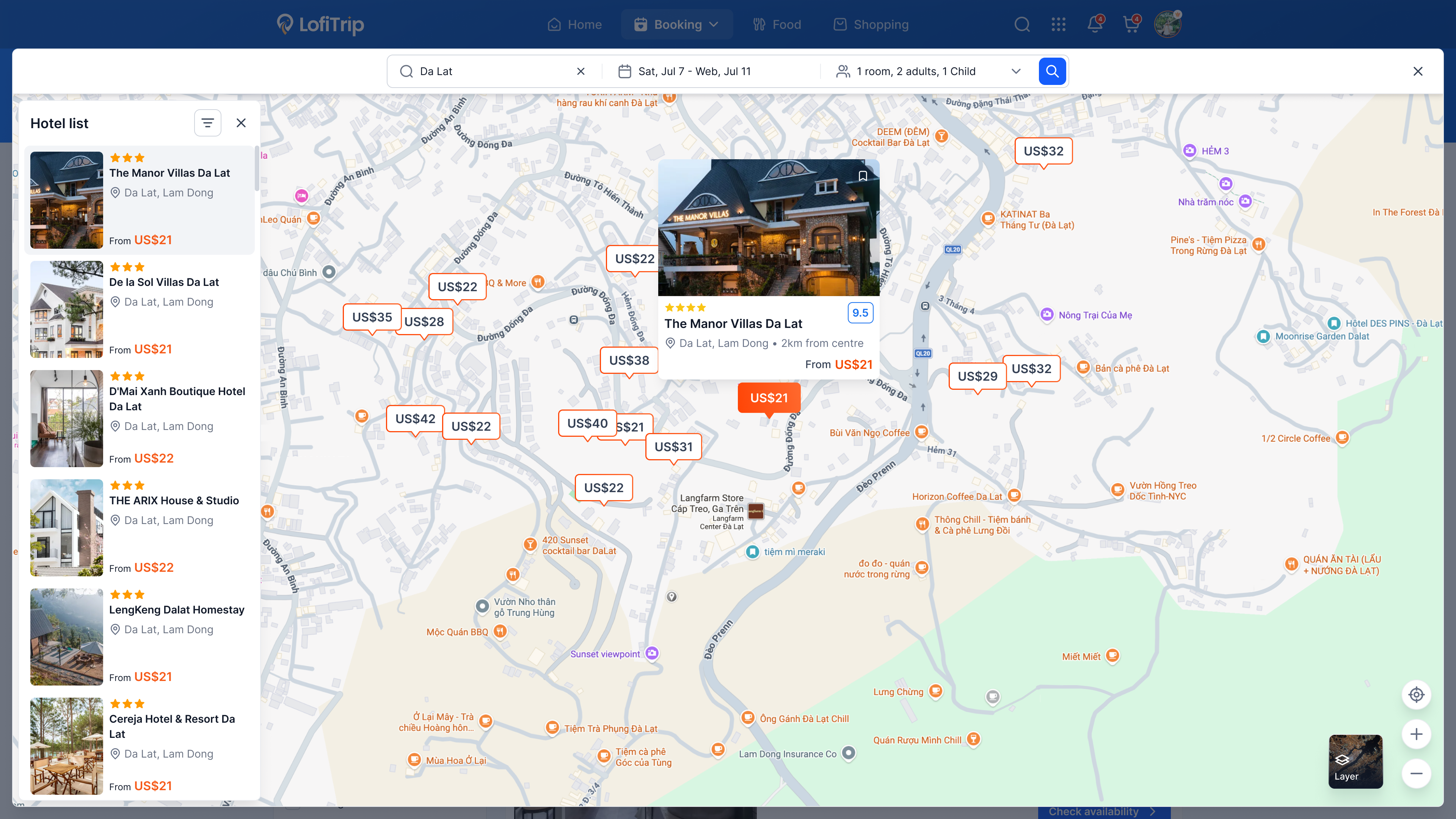
SCALING ACROSS SERVICES
Although this chapter focuses on Hotel booking, the same booking principles were reused across Flights, Cars, and Tours. Shared capabilities provided a consistent foundation, while service-specific business rules adapted the experience to each travel product without redesigning the entire platform.
Flight Booking
Tour Booking
View tour
OTA PARTNER EXPERIENCE
Behind every successful booking was a partner responsible for keeping inventory accurate and services available. The Partner Center was designed to simplify daily operations, from onboarding and property setup to inventory management, reservation tracking, and revenue monitoring. Rather than focusing on individual bookings, the experience helped partners maintain reliable operations while staying synchronized with the shared booking platform.
List the property
Add rooms
Rate plans
Availability
OPERATIONS EXPERIENCE
While travelers and partners interacted with bookings directly, the Operations Platform ensured the entire ecosystem remained reliable and scalable. Internal teams managed partner onboarding, voucher campaigns, financial reconciliation, customer support, and booking exceptions through a centralized operational workspace. These tools enabled the business to monitor every booking lifecycle, resolve issues efficiently, and maintain platform health behind the scenes.
Hotel Admin
A single booking illustrates more than one user journey. It demonstrates how platform decisions, operational workflows, and business rules come together to create a seamless travel experience.
PLATFORM IMPACT
Rather than building another standalone booking application, the project established a shared booking platform that connected multiple travel services through a common foundation.
More importantly, it enabled booking to become a natural extension of the broader travel ecosystem. By providing reusable booking capabilities, the platform created the foundation for integrating travel discovery, shared itineraries, and social content into bookable experiences without requiring separate booking products for each service.
BUSINESS IMPACT
The platform unified travelers, partners, and internal operations through a standardized booking lifecycle while supporting the unique business requirements of Hotels, Flights, Cars, and Tours.
Beyond improving operational consistency, it shortened the journey between travel inspiration and transaction. Rather than treating booking as a separate destination, it became a seamless continuation of discovery, allowing the ecosystem to connect content, planning, and commerce within a single experience.
DESIGN IMPACT
The achievement I’m most proud of wasn’t a single screen or interaction.
It was designing a platform that balanced two fundamentally different user mindsets. Travelers could move naturally from discovering destinations and planning trips to completing bookings without feeling like they were switching between disconnected products.
Behind that simple experience was a platform capable of supporting partners, business operations, and multiple travel services through one shared foundation.
Beyond the product itself, this project also transformed the way our design team worked.
When we started, the team consisted mostly of junior designers. We approached problems feature by feature, with limited exposure to complex business systems or platform thinking. As the product evolved, we gradually shifted our mindset from designing isolated interfaces to understanding business workflows, system dependencies, and the relationships between multiple stakeholders.
Over the past three years, we built more than screens. We built a shared design language, established a systems-thinking approach, and encouraged designers to challenge requirements, collaborate closely with Business Analysts and Product Managers, and understand the reasoning behind every business decision instead of simply executing requests.
Looking back, one of the outcomes I’m most proud of isn’t only the platform we delivered, but the foundation we built together. Watching the team grow from designing individual features to confidently contributing to complex product decisions has been one of the most rewarding parts of this journey.
The platform will continue to evolve, but more importantly, so will the people who helped build it. That may be the most valuable outcome this project has given me as a design leader. 🌅
The Magic Team ❇️